

Blog Details
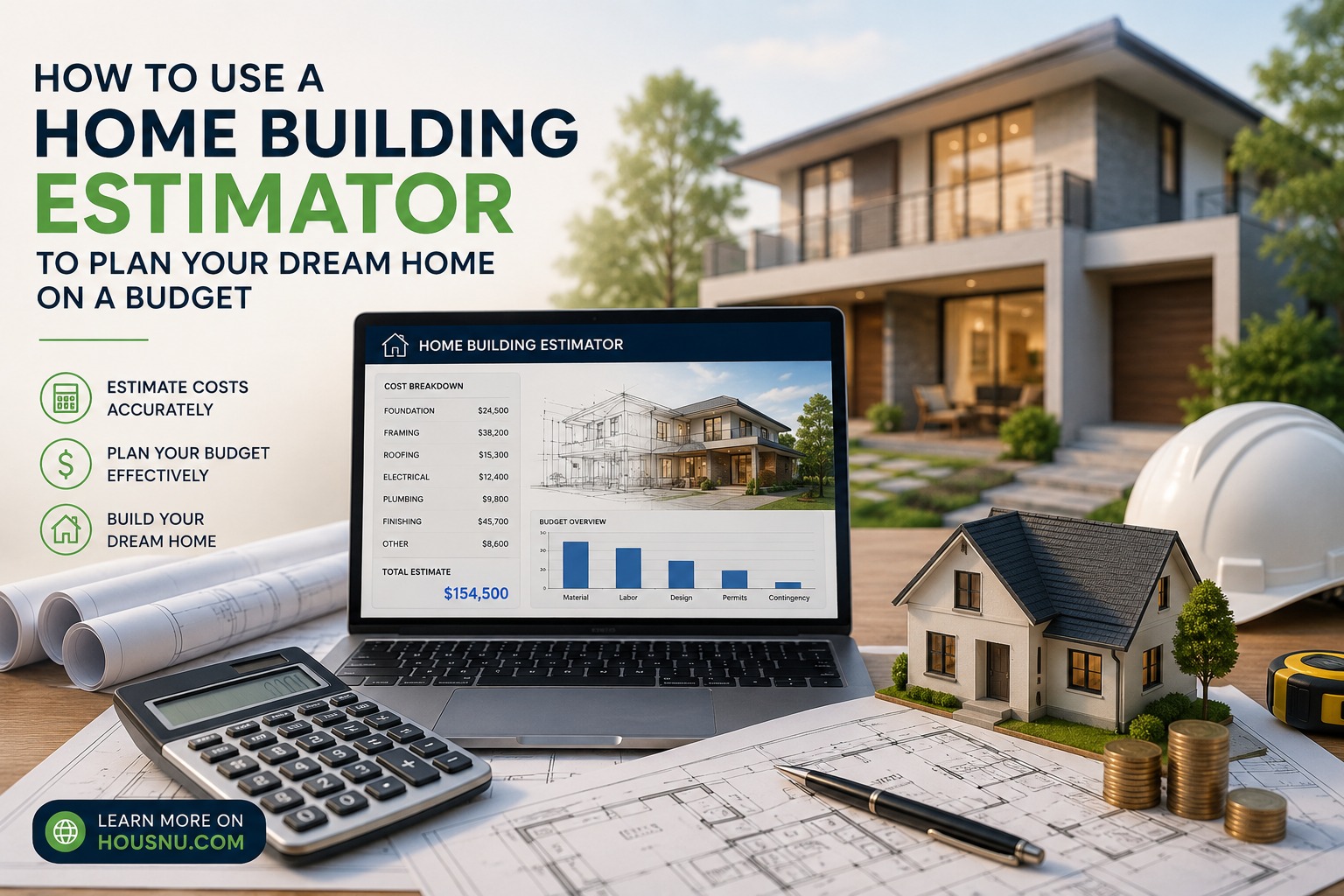
How to Use a Home Building Estimator to Plan Your Dream Home on a Budget

Authored by
Admin
Date Released
22 May, 2026
A practical, step-by-step guide to taking control of your construction costs before a single brick is laid using the right tools from day one.
“Building a home is one of the biggest financial decisions of your life. Studies consistently show that over 90% of first-time home builders go over budget not because they spent lavishly, but because they planned blindly. The antidote? A good estimator, used early and often.”
What Is a Home Building Estimator?
A home building estimator is a digital tool that helps you calculate the realistic cost of constructing a house before you hire a contractor, purchase land, or commit to a floor plan. It works by taking in your project inputs (size, location, materials, number of stories, finishes) and generating a detailed cost breakdown covering everything from foundation to roof.
Housnu's Budget Estimator is built specifically for aspiring homeowners who want a clear financial picture early in the process. It's designed to be accessible with no construction background needed while still producing the kind of itemized, accurate output that helps you have intelligent conversations with architects, contractors, and lenders.
Think of it as your financial co-pilot for the build: it doesn't replace a licensed quantity surveyor, but it gives you a powerful starting point so you're never walking into a meeting uninformed.
94%of custom home projects start over budget by ~30% | 30- 50%of total build cost is typically labor alone | 10-15%contingency buffer recommended on any new build |
Why You Should Never Skip the Estimator Step
Many homeowners jump straight to finding a contractor or browsing house plans without first establishing a realistic budget. This approach almost always leads to painful surprises either mid-build when funds run dry, or post-construction when you're sitting on debt you didn't plan for.
"Accurate building cost estimation forms the financial foundation of any successful home construction project. Without a precise budget, homeowners face the significant risk of cost overruns, delays, and compromising on desired features."
An estimator like the one at budget-estimator solves this by giving you a concrete number to anchor all downstream decisions. Here's what changes when you use one:
🎯Budget AccuracyGet a realistic picture of total construction costs before you're emotionally invested in a design |
|
| 🏦Smarter FinancingLenders and banks respond better when you arrive with detailed, credible cost projections. |
Step-by-Step: How to Use Housnu's Budget Estimator
Using Housnu's Budget Estimator is straightforward. Here's how to get the most out of it:
1. Define Your Home's Scope
Start with the basics: total square footage, number of stories, room count, and any special features like a basement, garage, porch, or open-plan kitchen. The more specific your inputs, the more accurate the output. A vague "3-bedroom house" produces very different numbers than "1,800 sq ft, 2-story, 3BR/2BA with attached double garage."
2. Input Your Location
Construction costs vary wildly by region, labor rates, material availability, and permit costs differ city by city. A location-aware estimator adjusts these variables for you, so you're not working from national averages that may be off by 40% for your specific market.
3. Select Material & Finish Quality
Choose between standard, mid-range, or premium finishes for flooring, kitchen, bathrooms, and exterior. This step is where most people discover surprising cost gaps: switching from standard tile to natural stone in a bathroom, for example, can shift your total budget by more than you'd expect.
4. Account for Soft Costs
Don't forget architect fees, engineering, permits, soil testing, and financing charges. These "soft costs" typically represent 10–20% of your hard construction budget and are the most commonly overlooked expense by first-time builders.
5. Add Site Preparation Costs
Grading, utility connections, driveway construction, and landscaping are real costs that don't appear in square-footage rules of thumb. Enter these separately to get a true all-in number.
6. Set a Contingency Buffer
Industry standard is 10–15% of hard costs. This isn't pessimism, it's realism. Unexpected site conditions, material price fluctuations, or design changes mid-build are the rule, not the exception. Build this buffer in from the start.
Practical Tips to Stay Within Budget
1. Lock in Your Scope Early
The single most expensive thing you can do on a build is change your mind mid-construction. Every design change after work begins costs 2–5× what it would have cost in the planning stage. Use the estimator to experiment with different layouts digitally where changes are free.
2. Prioritize Where Premium Matters
Not every room deserves the top-tier finish. A good budgeting strategy is to allocate premium materials to the kitchen and primary bathroom (they drive resale value the most) and pull back on spaces like utility rooms, secondary bathrooms, or guest rooms. Your estimator helps you see the dollar impact of these choices in real time.
3. Run Multiple Scenarios
The power of a digital estimator is that you can run "what-if" scenarios instantly. What happens if you reduce from 2,500 sq ft to 2,100? What if you choose vinyl flooring instead of hardwood? Build 3–4 budget scenarios (conservative, moderate, ideal) and present all of them to your contractor for discussion.
4. Get Three Contractor Quotes
Armed with your estimator output, contact at least three licensed contractors and compare their quotes against your projection. A quote that comes in significantly lower than your estimate isn't necessarily a bargain — it may signal the contractor has missed items or plans to cut corners. Your estimate is your quality benchmark.
5.Don't Forget Ongoing Costs
Property taxes, homeowner's insurance, utility hookup fees, and HOA dues (where applicable) all start the day you move in. A complete budget includes a post-construction financial plan, not just the build itself.
FAQ’s
1. What is a home building estimator and how does it work?
A home building estimator is a digital tool that calculates the estimated cost of building a house based on factors like square footage, location, materials, labor, and design features. It helps homeowners understand realistic construction costs before starting the project.
2. How accurate are online home building estimators?
Most modern estimators provide a strong starting estimate when detailed project information is entered correctly. While they are not a replacement for a contractor’s final quote, they help homeowners plan budgets more accurately and avoid major financial surprises.
3. Can a home building estimator help reduce construction costs?
Yes. A home building estimator allows you to compare different layouts, materials, and finish options before construction begins. This helps you make smarter financial decisions and identify areas where you can save money without sacrificing quality.
4. What costs should I include when estimating a home build?
You should include hard costs like foundation, framing, roofing, labor, and materials, as well as soft costs such as permits, architect fees, inspections, utility connections, landscaping, and a contingency reserve for unexpected expenses.
5. Why is a contingency budget important in home construction?
A contingency budget protects you from unexpected expenses such as material price increases, weather delays, design changes, or hidden site issues. Most experts recommend setting aside 10-15% of the total construction budget for contingencies.
Focused Keyword
- Home Building Estimator
- Budget Estimator
No comments Yet. Be the first to comment!



Leave a Comment